GST on Transportation of Goods: Rates, Who Pays and Exemptions
Table of Contents
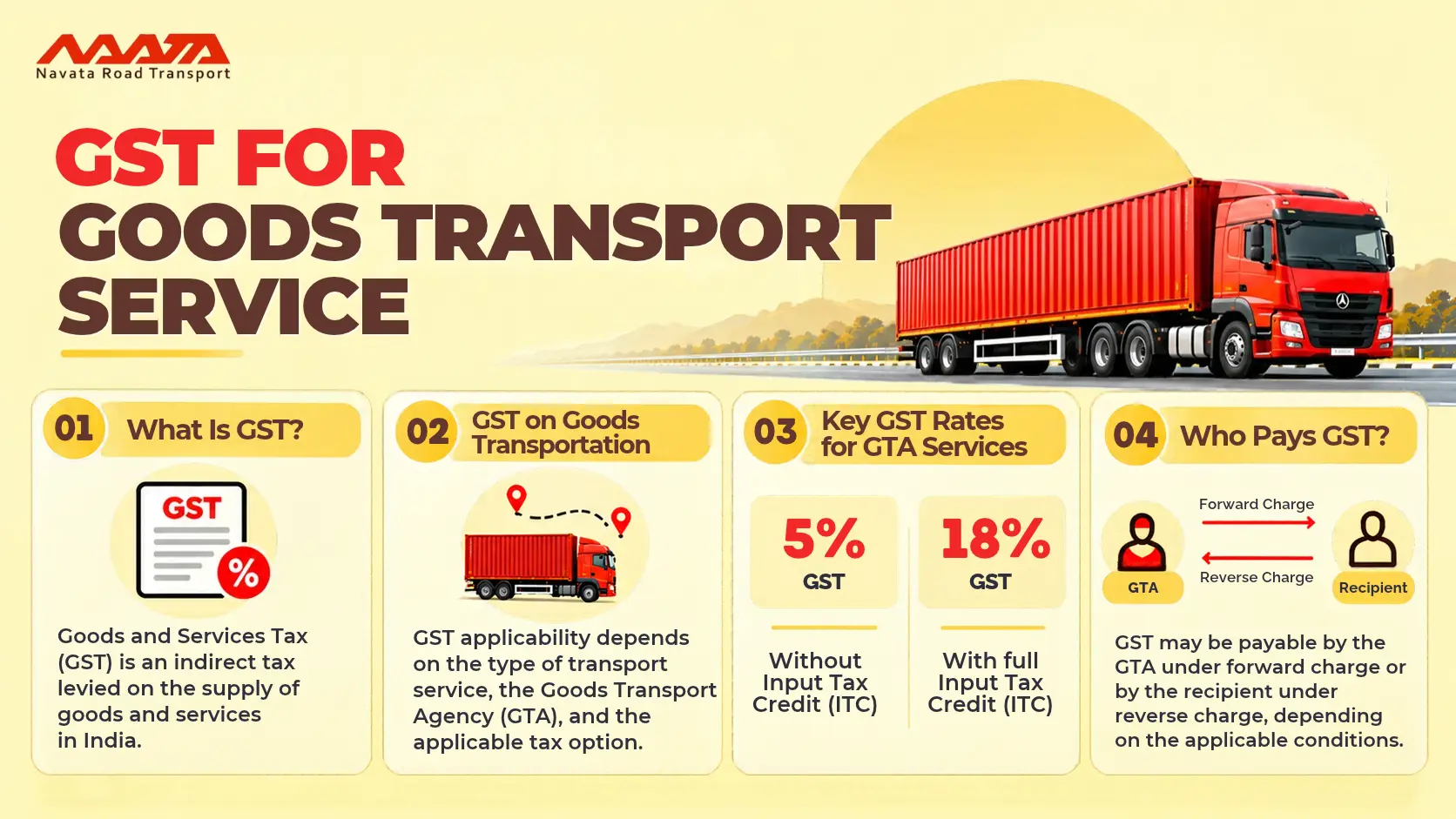
GST for Goods Transport Services
GST on transportation of goods by road is charged at 5% when a goods transport agency (GTA) does not take input tax credit, or 18% when the GTA opts to charge GST and claim full input tax credit. These rates apply from 22 September 2025, when the 18% option replaced the earlier 12% option. Transport by a truck owner who is not a GTA is exempt, and so is GTA transport of certain essential goods.
This guide covers GST on goods transport services in one place: the transport GST rate for each type of service, how GST on transportation of goods by road depends on whether the transporter is a GTA, who pays GST on transport services under reverse charge and forward charge, the input tax credit effect of 5% and 18%, the exemptions that still apply, and a worked example of one freight bill.
Transport GST rate from 22 September 2025
The transport GST rate depends on who provides the service and how it is provided. The table lists the rates for goods transport services that a shipper is most likely to meet. The percentages are total GST: for a supply within one state they are split equally into CGST and SGST, and for a supply between states the full rate is charged as IGST.
| Service | GST Rate | Input Tax Credit | Who Pays |
|---|---|---|---|
| Road transport by a goods transport agency (GTA) | 5% | No input tax credit for the GTA | Either the recipient pays under reverse charge or the GTA pays under forward charge |
| Road transport by a GTA that opts for the higher rate | 18% | Full input tax credit | The GTA charges GST on its invoice (forward charge) |
| Road transport by a person who is not a GTA (no consignment note issued) | Exempt | Not applicable | No GST on the freight |
| Hiring a truck or other goods carriage to a GTA | Exempt | Not applicable | No GST on the hire charge |
| Renting a goods carriage with operator, fuel included | 5% or 18% | 5%: restricted credit. 18%: full credit | The supplier charges GST |
| Multimodal transport with no air leg | 5% | Restricted credit | The multimodal transporter charges GST |
| Multimodal transport that includes air | 18% | Full input tax credit | The multimodal transporter charges GST |
| Containers by rail by a container train operator | 5% or 18% | 5%: no credit. 18%: full credit | The operator charges GST |
Other modes, such as goods carried by Indian Railways, by air within India or by inland waterways, have their own entries in the rate notifications. Check the current notification for the mode you use before you invoice.
GST on transportation of goods by road: GTA or not
GST on transportation of goods by road turns on one question: is the transporter a goods transport agency? The answer decides whether GST applies at all, and at which rate.
What makes a transporter a GTA
Under GST, a goods transport agency is a person who provides a service in relation to the transport of goods by road and issues a consignment note, by whatever name it is called. In road freight the consignment note is usually the lorry receipt (LR). The consignment note is the deciding document: a transporter that issues one is treated as a GTA for that service.
From 22 September 2025 the definition excludes e-commerce operators that provide, or through which others provide, local delivery services.
Transport by a truck owner who is not a GTA
Transportation of goods by road is exempt from GST when the service is not provided by a GTA or a courier agency. A truck owner who carries goods without issuing a consignment note therefore charges no GST on the freight. Courier services do not fall under this exemption.
Hiring or renting a truck
Hiring a truck or other goods carriage to a GTA is exempt. This lets a GTA hire vehicles from individual owners without that hire charge carrying GST. Renting a goods carriage with an operator to anyone else is taxed at 5% with restricted input tax credit, or at 18% with full input tax credit, where the rent includes the cost of fuel.
You may also like to read: A Guide to GST for Good Transportation Agency and Truck Owners
Who pays GST on transport services
GST on transport services provided by a GTA can be paid in two ways. Under reverse charge the recipient of the service pays the tax to the government. Under forward charge the GTA charges GST on its invoice and pays it itself.
Reverse charge: when the recipient pays
When a GTA charges 5% and has not opted to pay GST itself, the tax is paid under reverse charge by the recipient of the service, if the recipient is one of the following:
- A factory registered under the Factories Act, 1948
- A society registered under the Societies Registration Act, 1860
- A co-operative society
- A person registered under GST
- A body corporate
- A partnership firm, whether registered or not
- A casual taxable person
Government departments and local authorities that are registered only to deduct tax at source are kept outside this reverse charge rule.
Forward charge: when the GTA pays
A GTA can choose to pay GST itself by filing a declaration in Annexure V between 1 January and 31 March of the financial year before the year it applies to. Once made, the choice continues for later years. To return to reverse charge, the GTA files Annexure VI in the same January to March window.
Under forward charge the GTA can charge 5% without input tax credit or 18% with full input tax credit. For the detailed registration, invoicing and return-filing steps a GTA follows, see the guide to GST for goods transport agencies and truck owners.
5% or 18%: what changes for input tax credit
The two rates trade a lower tax on the freight against the right to claim credit. At 5%, the GTA cannot take input tax credit on the goods and services it uses to provide the transport service, such as trucks, spare parts or repairs bought with GST. At 18%, the GTA charges more GST on the freight but can claim full credit for the GST it pays on those inputs.
Which option suits a GTA depends on how much GST it pays on its own costs and on its customers. For a business customer that can claim credit for the GST it is charged, the higher rate may make little difference to its final cost; a customer that cannot claim credit pays more. Whether the recipient can claim credit for GST it pays depends on its own use of the service, so confirm that with your tax adviser.
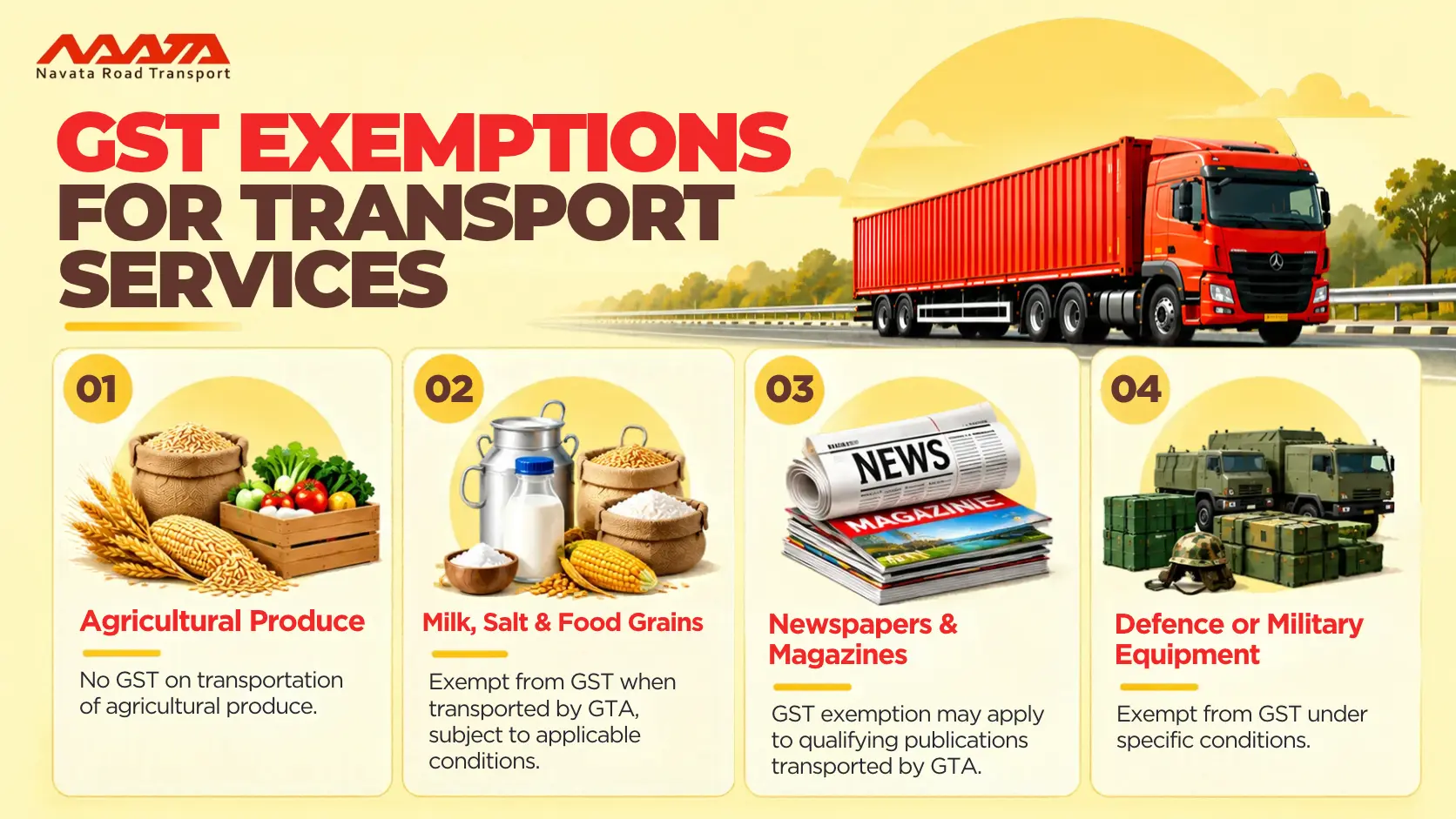
Goods transport that is exempt from GST
GTA services are exempt when they are supplied to an unregistered person, including an unregistered casual taxable person, other than a factory, a society, a co-operative society, a body corporate or a partnership firm. GTA services are also exempt when the goods carried in the goods carriage are:
- Agricultural produce
- Milk, salt and food grain, including flour, pulses and rice
- Organic manure
- Newspapers or magazines registered with the Registrar of Newspapers
- Relief materials for victims of natural or man-made disasters, calamities, accidents or mishaps
- Defence or military equipment
Until 17 July 2022, GTA freight of up to Rs 1,500 for a consignment carried in a single carriage, and up to Rs 750 for all goods carried for a single consignee, was exempt from GST. Both exemptions were removed with effect from 18 July 2022. Such freight is now taxed at the normal GTA rate unless the goods themselves are in the exempt list above.
Worked example: GST on one freight bill
A GTA carries goods by road for a manufacturer that is registered under GST, for a freight charge of Rs 50,000. The table shows the GST under each option the GTA can be under.
| Item | GTA on 5%, Reverse Charge | GTA on 5%, Forward Charge | GTA on 18%, Forward Charge |
|---|---|---|---|
| Freight charged | Rs 50,000 | Rs 50,000 | Rs 50,000 |
| GST rate | 5% | 5% | 18% |
| Who pays the GST | The manufacturer, under reverse charge | The GTA, on its invoice | The GTA, on its invoice |
| GST amount | Rs 2,500 | Rs 2,500 | Rs 9,000 |
| Total on the GTA invoice | Rs 50,000 | Rs 52,500 | Rs 59,000 |
| Input tax credit for the GTA | No | No | Yes, full credit |
The amounts follow directly from the rates. Which column applies depends on the option the GTA has chosen for the year, so the GTA and its customer should agree it before the first invoice.
Consignment note, invoice and e-way bill
A road consignment usually travels with the supplier’s tax invoice or delivery challan, the GTA’s consignment note and, where it applies, an e-way bill. The consignment note shows the transporter is acting as a GTA, which is what brings the GTA rates and the reverse charge rules into play. For when an e-way bill is needed, its validity and how Part B is updated, see e-way bill rules for road freight.
Freight terms also depend on the load. A full truckload and a part load are priced differently, which changes the freight value on which GST is calculated. See FTL shipping, LTL shipping and truck load capacity in India for how those loads work.
Conclusion
GST on transportation of goods comes down to three questions: is the transporter a GTA, which rate option has the GTA chosen, and is the recipient one of the businesses that pays under reverse charge. Since 22 September 2025, a GTA charges 5% without input tax credit or 18% with full credit, the old 12% option is gone, and the Rs 1,500 and Rs 750 freight exemptions no longer apply.
Sources
The rates and rules in this guide were checked on 6 October 2026 against these official sources and against the texts of Notification No. 12/2017-Central Tax (Rate) (exemptions) and Notification No. 15/2025-Central Tax (Rate) (rates and GTA definition from 22 September 2025). GST rates can change after that date, so confirm the current notification before invoicing.
- Ministry of Finance FAQs on the 56th GST Council decisions (3 September 2025), FAQ 60 to 62
- Notification No. 03/2022-Central Tax (Rate), GTA rate entry and forward-charge option
- Notification No. 32/2017-Central Tax (Rate), GTA services to unregistered persons
- Notification No. 04/2022-Central Tax (Rate), omission of the Rs 1,500 and Rs 750 GTA exemptions
- Notification No. 06/2023-Central Tax (Rate), Annexure V and Annexure VI window
- Notification No. 10/2017-Integrated Tax (Rate), reverse charge recipients for GTA services
What is the GST rate on transportation of goods by road?
Who pays GST on transport charges?
Is the 12% GST rate for GTA still available?
Is freight below Rs 1,500 or Rs 750 still exempt from GST?
How does a GTA choose to pay GST under forward charge?
Navata Road Transport has been delivering trust since 1982. Work out your freight before you book.
Thanks For Reading: GST for Goods Transport Services: A Comprehensive Guide
Recent Posts