What is EPOD? Electronic proof of delivery explained
Table of Contents
What is EPOD (Electronic Proof Of Delivery)?
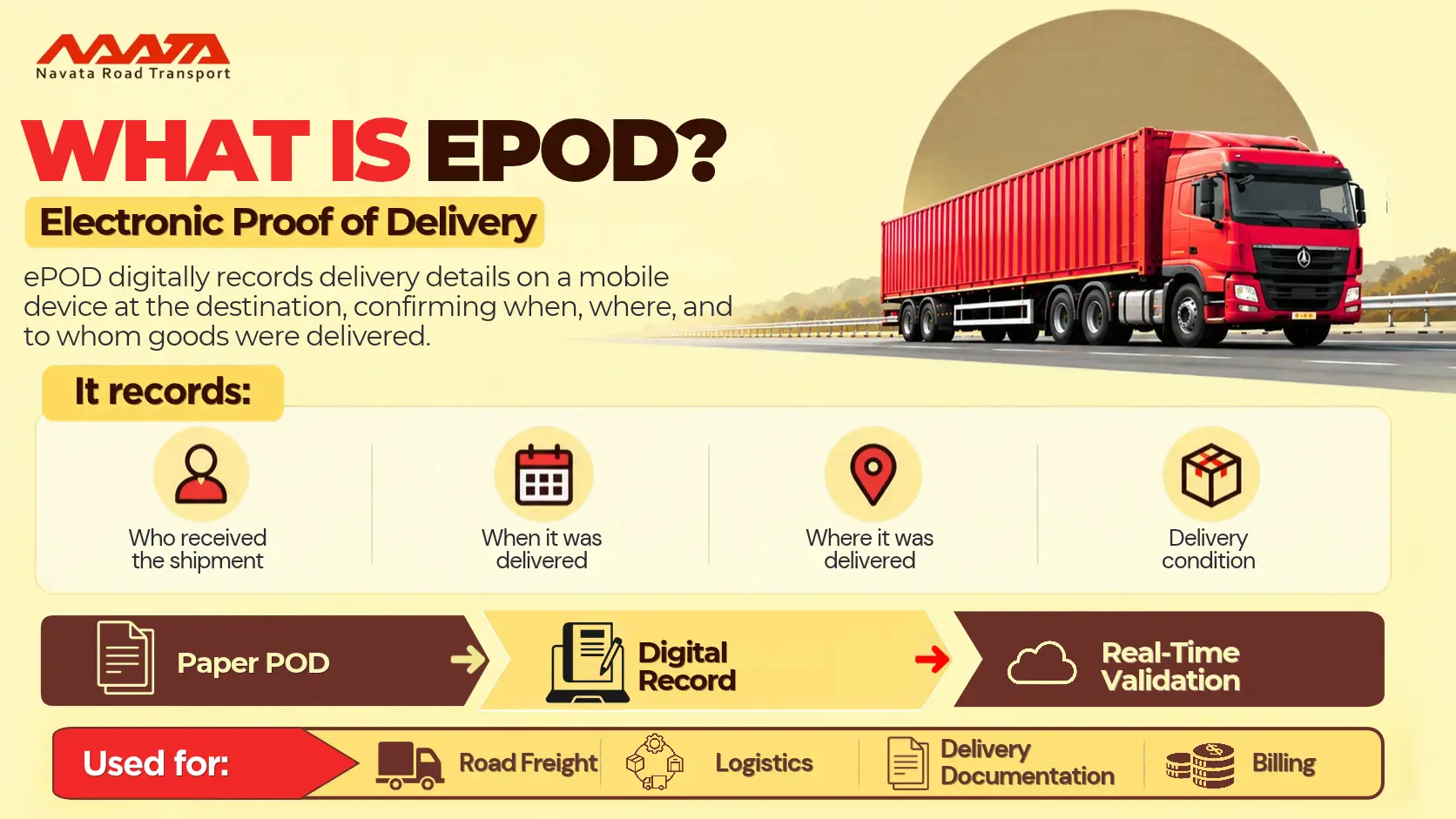
EPOD is the short form of Electronic Proof of Delivery, a digital record captured on a phone or handheld device at the delivery point. It records who received the consignment, when and where it was delivered, and in what condition. It replaces paper-based proof of delivery, and the record is uploaded to a central system for real-time validation.
This guide covers the EPOD full form and meaning, what an EPOD records, how electronic proof of delivery works step by step, how it compares with paper POD, where it is used, its benefits for logistics teams, and how it fits into road freight billing in India.
EPOD full form and meaning
The EPOD full form is Electronic Proof of Delivery. Some companies write it as ePOD or e-POD, and all three mean the same thing. A POD (proof of delivery) is the record that confirms goods were received. The “E” means that record is captured and stored digitally instead of on paper.
The EPOD meaning in logistics goes a little further than a digital signature. A complete EPOD links the recipient’s acknowledgement to the shipment record, together with a timestamp, the delivery location and notes on the condition of the goods, so the delivery status can be shared with the teams that need it.
You May Also Like to Read: The Future of Transportation Management Systems
What does an EPOD record?
The exact fields depend on the software and on what each customer requires. A typical EPOD captures:
- Recipient name and signature, taken on the driver’s device screen.
- Date and time of delivery, recorded automatically.
- GPS location of the delivery point.
- Photos of the goods, the unloaded consignment or the delivery area.
- Quantity delivered, with notes on any damage.
- A one-time PIN or code shared with the recipient, where the customer uses one to confirm the handover.
- The shipment or consignment reference, so the record matches the right order or lorry receipt.
How electronic proof of delivery works
The steps below follow a typical delivery run. They are the same whether the goods are a single parcel or a full truckload.
- Delivery assignment: the driver receives the day’s deliveries on a mobile device, with addresses and any customer-specific instructions.
- Data capture: at the delivery point, the driver opens the consignment in the app and records the details that the customer requires.
- Digital signature: the recipient signs on the device screen to acknowledge receipt.
- Photos: the driver photographs the goods or the delivery area, especially where packaging is damaged.
- Timestamp and GPS: the app records the exact time and location of the handover.
- Real-time upload: the record is sent to the central system.
- Verification and storage: the system checks the record against the shipment, flags exceptions, and stores the EPOD for billing, customer queries, and audits.
Key components of EPOD
1. Mobile devices
Smartphones or tablets with a camera, GPS, and a touch screen let drivers capture and send delivery details at the delivery point.
2. EPOD software
The software controls how data moves from the delivery point to the main server. Common features include signature capture, photo upload, real-time tracking and automatic data synchronisation.
3. Digital signatures
Electronic signatures let recipients confirm delivery without pen and paper. The signature is saved with the delivery record, so it can be retrieved later along with the rest of the shipment details.
POD vs EPOD: paper and electronic proof of delivery compared
| Aspect | Paper POD | EPOD |
|---|---|---|
| How it is captured | Signature on a paper delivery copy | Signature, photos and delivery details captured on a mobile device |
| When the office receives it | After the paper copy is returned | When the record is uploaded after delivery |
| Time and location | Entered manually, where recorded | Timestamp and GPS location recorded by the device |
| Condition of goods | Written remarks, where recorded | Photos can be attached to the record |
| Use in billing | Checked against the lorry receipt once the paper copy is received | Available to finance teams for invoicing and reconciliation after upload |
Where EPOD is used
1. Retail and e-commerce
Electronic collection of signatures and delivery details reduces errors and disputes. For businesses without physical stores, the delivery is the final point of contact with the customer.
2. Logistics and transportation
Carriers and logistics providers use EPOD to confirm deliveries as they happen, keep customers informed and keep delivery records available for billing and queries. EPOD is also used in last-mile delivery operations.
3. Manufacturing and distribution
Manufacturers use EPOD to confirm that goods reached distributors or plants as specified, which lowers the chance of discrepancies and gives them a record for audits.
4. Field service
Service teams use the same tools to confirm completed jobs on site and record the time spent, which supports accurate billing.
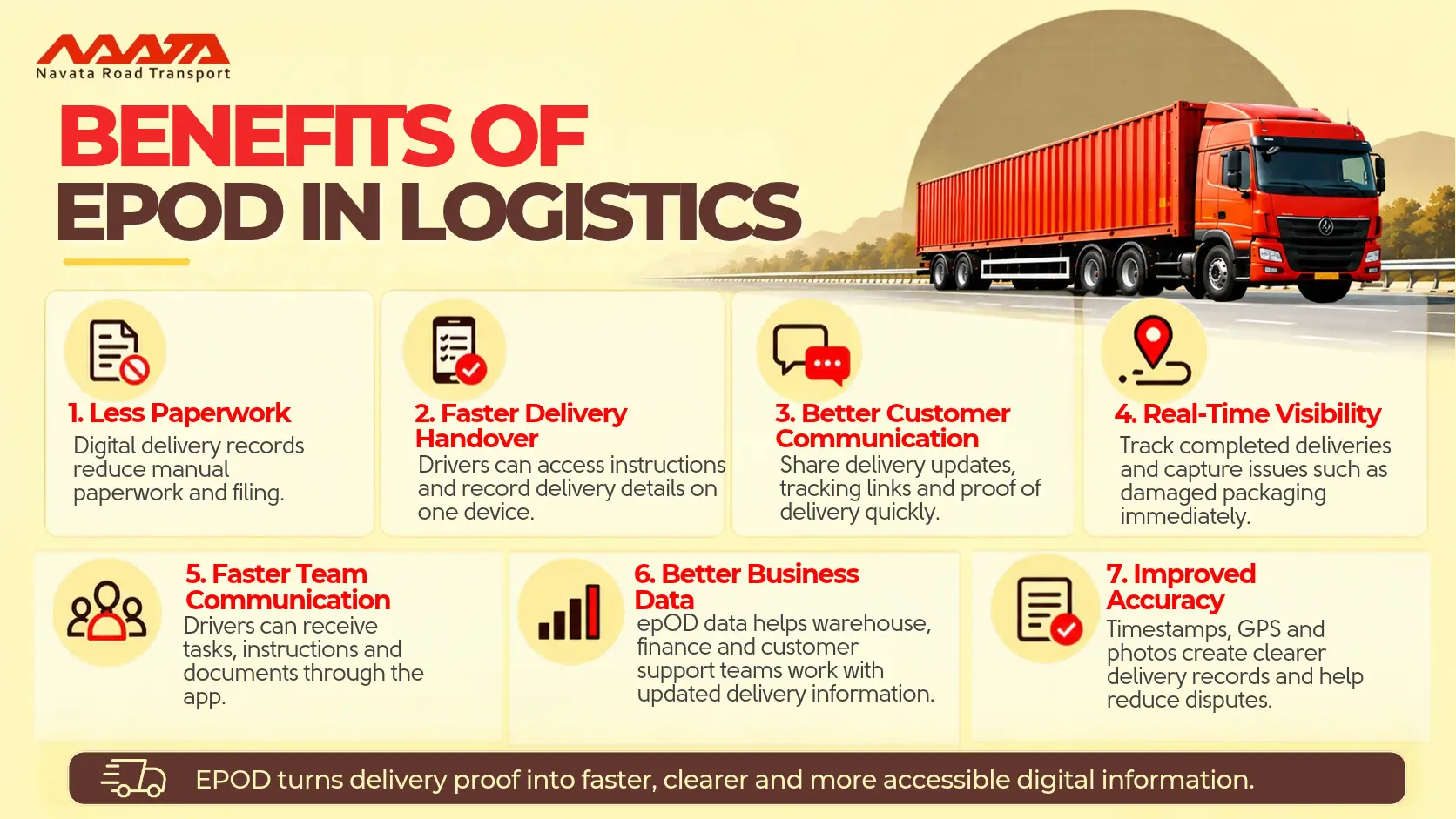
Benefits of EPOD in logistics
These benefits apply to any business that delivers goods. EPOD in logistics is closely tied to billing, because freight is often invoiced and reconciled against the proof of delivery.
1. Less paperwork
Delivery data reaches the office as soon as it is captured, so staff no longer collect, sort and file paper copies before they can close a delivery.
2. Better service at the delivery point
Drivers have customer-specific instructions on the same device they use to record the delivery. A simple app keeps the handover quick and reduces mistakes.
3. Clearer customer communication
Businesses can send pre-delivery notifications by SMS or email with estimated times and tracking links, and share the proof of delivery with the customer once the goods are handed over.
4. Real-time visibility
Operations teams see deliveries as they are completed. A photo of damaged packaging lets them act quickly, for example by rescheduling the delivery or agreeing next steps with the customer. Where goods have to come back, the return is handled through reverse logistics.
5. Faster team communication
Drivers receive tasks, instructions and documents through the app instead of calling or visiting the office. Where a fleet also uses fleet telematics, vehicle location data is available alongside delivery records.
6. Useful data for other teams
Connected to other business systems, EPOD data helps warehouse staff update stock, finance teams raise invoices sooner and customer support answer queries with facts.
7. Better accuracy
Automatic timestamps, GPS and photos replace handwritten entries, which can reduce disputes about when, where and in what condition goods were delivered.
EPOD in Indian road freight
In road transport, proof of delivery is closely tied to the paperwork that travels with a consignment. The lorry receipt (LR) is issued when goods are loaded, and the proof of delivery is later matched against it during freight billing and reconciliation. Where the proof of delivery is a paper copy, reconciliation can only be completed once that copy has been received.
With EPOD, the delivery confirmation, photos and remarks are available once the record is uploaded, so they can be used in reconciliation without waiting for a paper copy.
Navata Road Transport shares an instant digital proof of delivery confirmation with customers, alongside tracking updates while shipments are in transit. To see how shipment tracking works on the road, read our guide to trucking tracking systems in India.
What you need to implement EPOD
Setting up EPOD is usually a smaller project than a full system change. A practical checklist:
- Devices for drivers: smartphones or handhelds with a camera, GPS and reliable mobile data.
- Agreed data fields: decide what every delivery must capture, such as signature, photos, quantity and consignment reference, and which fields are mandatory for each customer.
- Exception codes: set standard reasons for shortage, damage, refusal or an incomplete address, so exceptions are reported the same way every time.
- Integration: connect the EPOD app to your order system, transportation management system and billing so records flow without re-entry.
- Driver training: show drivers how to capture a complete record and what to do when a recipient will not sign.
- Access and retention: decide who can view delivery records and how long they are kept.
What is the full form of EPOD?
What does EPOD mean in logistics?
What is the difference between POD and EPOD?
Is an EPOD the same as a tracking update?
Key takeaway
EPOD, or Electronic Proof of Delivery, replaces paper delivery receipts with a digital record of who received the goods, when, where and in what condition. For shippers and transporters, that can mean faster billing, fewer disputes and a clearer view of each delivery.
Moving freight by road? Navata Road Transport has been delivering trust since 1982.
Explore our servicesThanks For Reading: What Is EPOD (Electronic Proof Of Delivery)?
Recent Posts